
Hello folks! If you have an Android phone in the EU, Google just got told to share its toys. Brussels has ordered Google to open up Android so that rival AI assistants, not just Gemini, can do the things Google Assistant has always been allowed to do. It is one of those regulatory stories that sounds dry until you realize it might change which app answers when you say a wake word on your own phone.
Quick answer: On July 16, 2026, the European Commission ordered Google to open 11 Android features to competing AI assistants and to share anonymized Google Search data with rival search engines. Search data sharing starts in January 2027, and the Android changes are due by July 2027. In practice, this means EU Android users should eventually be able to set a non-Google AI assistant as their default, wake it by voice, and let it act inside other apps the way Google Assistant does now.
What actually happened
The European Commission wrapped up six months of investigation and issued two binding decisions against Google under the Digital Markets Act, the EU law aimed at reining in Big Tech gatekeepers. This is the same law that forced Apple to allow alternative app stores in Europe, so it is worth reading about if you followed Apple’s own gatekeeper fight with Brussels.
The first decision covers AI on Android. Right now, Google’s own assistant gets deep access to system-level features on your phone, things like reacting to a wake word, seeing what app you’re in, or acting on your behalf inside other apps. Rival assistants from other companies have been stuck with much thinner access. The Commission says that has to change.
The second decision is about search. Google Search collects an enormous amount of data on what people click, search, and view. The EU wants competing search engines and AI chatbots with search features to get anonymized access to some of that same data, so they are not permanently stuck a step behind.
Key details: dates, features, and safeguards
Here is what we know so far, pulled straight from the Commission’s own announcement and independent reporting:
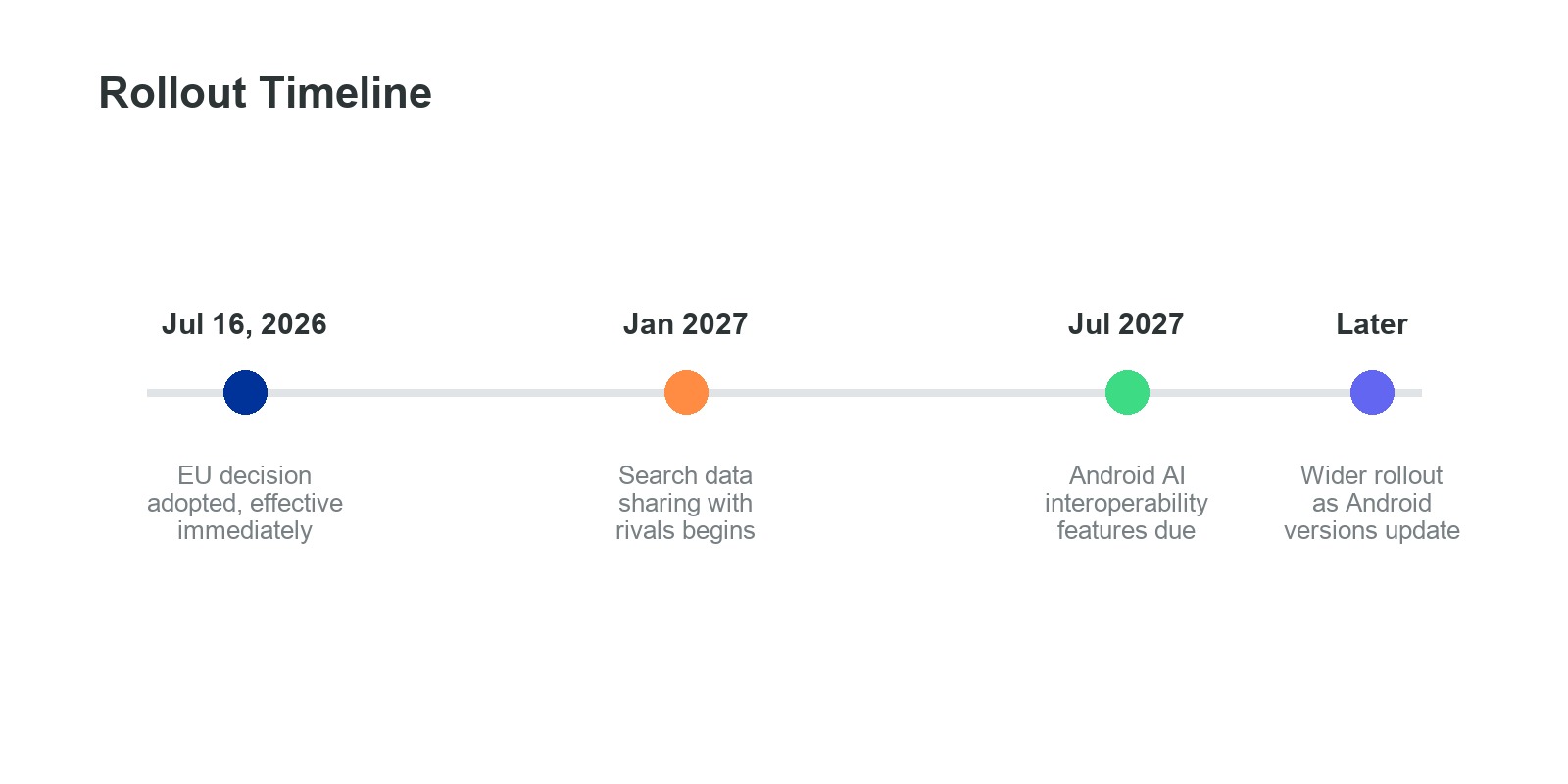
- Decision date: July 16, 2026, and it’s enforceable immediately, though the actual technical changes roll out later.
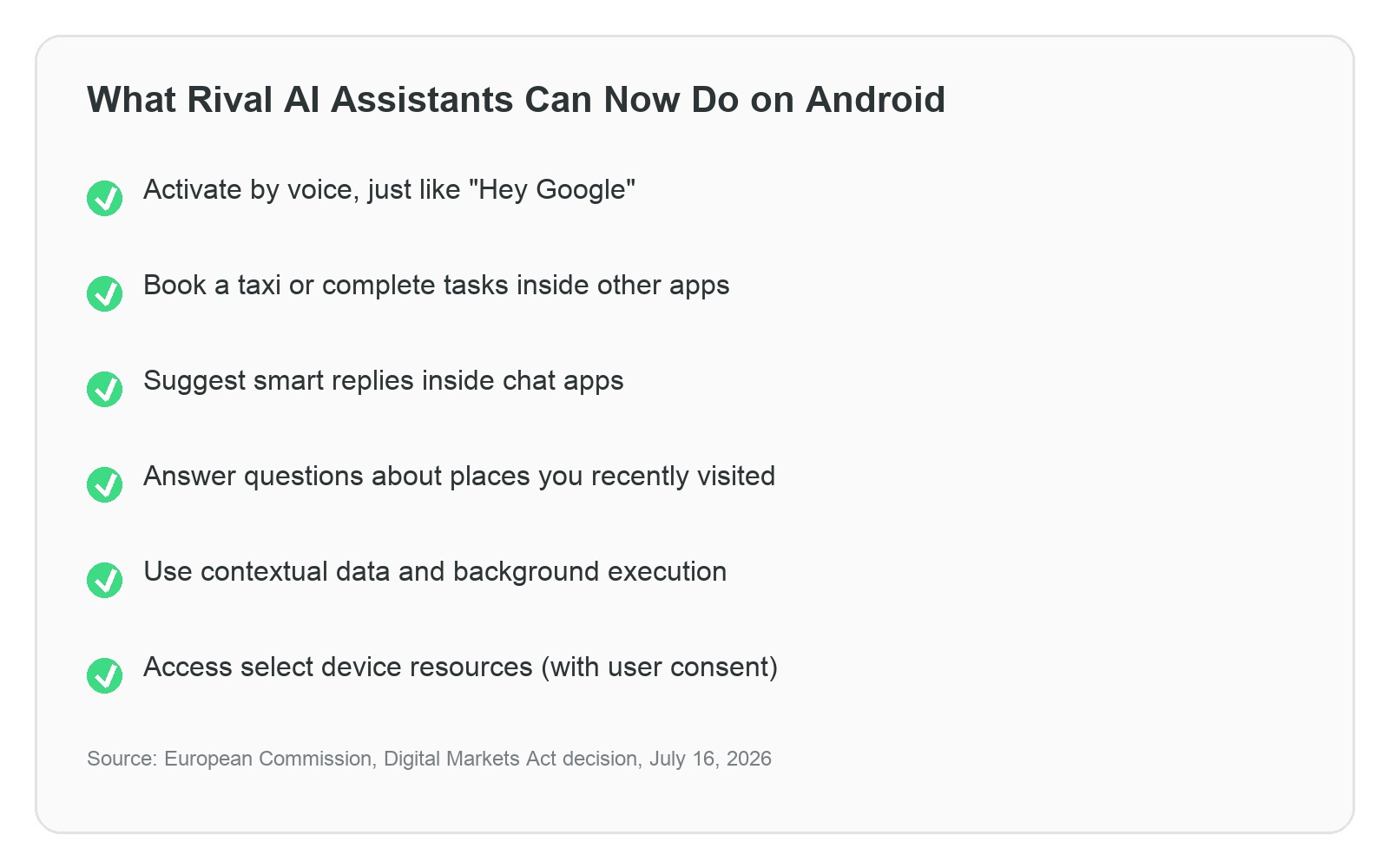
- Scope: 11 separate Android features are covered, including assistant invocation (the wake word), app functions, contextual data, background execution, and access to certain device resources.
- What a rival assistant could do: get activated by voice the same way “Hey Google” works today, take actions inside other apps like booking a taxi, suggest smart replies in your messaging apps, or answer a question about a place you visited recently.
- Search data sharing: begins in January 2027.
- Android AI interoperability: due by July 2027, tied to how Google rolls out future Android versions.
- Safeguards: the Commission says access is scoped, requires user consent, and that some of the more sensitive permissions need independent security certification first.
Google is not happy about any of this. In its response, the company argued that opening up system-level access this way could weaken privacy and security protections, and that private search activity could end up visible to companies users have never heard of. The Commission’s counter is that the safeguards exist precisely to stop that, and that Google has simply had an unfair head start for too long.
Why this matters if you own an Android phone
Right now, Google Assistant (or Gemini, depending on your phone) is the only assistant that gets the deep hooks into Android. Everything else feels bolted on. You can install another AI app, sure, but it can’t jump in when you say a wake word, and it usually can’t reach into your other apps to actually do something.
This decision is meant to level that out. If it works as intended, you’ll eventually be able to pick, say, ChatGPT or another assistant as your default, trigger it hands-free, and let it act across your apps the same way Google’s own assistant does. That’s a real change for anyone who prefers a different AI tool but has been stuck with Gemini as the “real” option on their phone.
I’ll be honest, I’m curious how messy this gets in year one. Deep system access for multiple competing AI apps sounds great in a press release, but battery life, permission fatigue, and security prompts are going to be the actual test. This is the kind of feature that reads better on paper than it might feel on day one.
How and when you’ll actually get this
You can’t do anything yet. This is a mandate on Google, not a feature you can toggle on today. Based on the timeline the Commission published, here’s roughly what to expect if you’re in the EU:
- Search-related changes start showing up behind the scenes from January 2027, mostly affecting how competing search engines work, not something you’ll directly click on.
- The Android assistant changes are due by July 2027, and they’ll likely arrive tied to a future Android version update rather than a random Tuesday patch.
- Outside the EU, don’t expect this automatically. The DMA only applies to Google’s conduct toward EU users, so whether these features ever reach US or other markets depends entirely on Google’s own choices.
What’s next
Google has already signaled it will push back, at least rhetorically, on security grounds, so expect more statements and possibly an appeal, similar to how Apple fought its own DMA rulings. The Commission has also left room to adjust the safeguards based on independent review, so the exact shape of this could still shift before 2027 arrives. Worth keeping an eye on which assistant makers (OpenAI, Perplexity, Samsung’s Bixby team, and others) actually build for this access once it’s available.
Frequently asked questions
Does this mean I can use ChatGPT instead of Google Assistant on Android right now?
Not yet. This is a legal order to Google with deadlines stretching into 2027. The actual features have to be built and rolled out first.
Will this apply outside the European Union?
Not automatically. The Digital Markets Act only governs Google’s behavior toward EU users, so any global rollout would be a separate decision by Google.
Is this the same case as Apple’s fight with the EU?
No, but it’s the same law. The Digital Markets Act has already forced changes on Apple, like allowing alternative app stores, and now it’s Google’s turn on Android and Search.
Why is Google against this if the EU says it’s safe?
Google argues that letting outside apps deeper into Android’s system could expose private data or weaken security, even with the EU’s stated safeguards. The Commission disagrees and says the access is scoped and consent-based.
Sources: European Commission, Digital Markets Act decision and Android Authority.
Would you actually switch away from Google Assistant if you had a real choice on Android, or has Gemini already won you over?