
Hello folks! Samsung just held its summer Unpacked event in London, and the big foldable refresh is finally official. If you’ve been holding onto your Z Fold 7 or Z Flip 7 waiting to see what’s next, the wait is over — and so is the surprise that everything got a little more expensive.
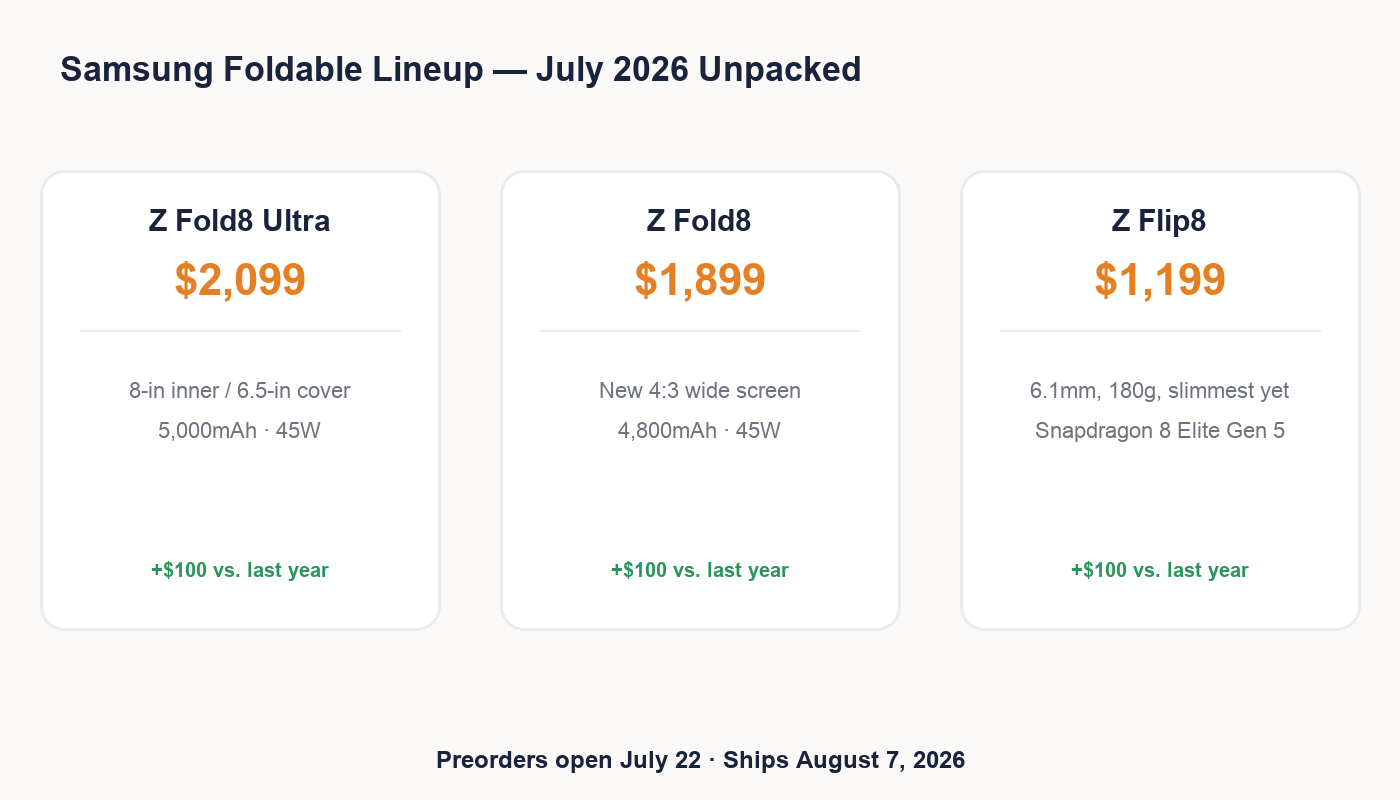
Quick answer: Samsung announced the Galaxy Z Fold8 Ultra ($2,099), Galaxy Z Fold8 ($1,899), and Galaxy Z Flip8 ($1,199) on July 22, 2026. All three run the new Snapdragon 8 Elite Gen 5 chip, get bigger batteries, and ship in the US on August 7. Every model costs $100 more than last year’s version, though the Fold8 Ultra is now thinner and the regular Fold8 has a completely new, wider shape.
What Samsung actually announced
Samsung split its Fold lineup in two this year. Instead of one Z Fold, you now get two real choices:
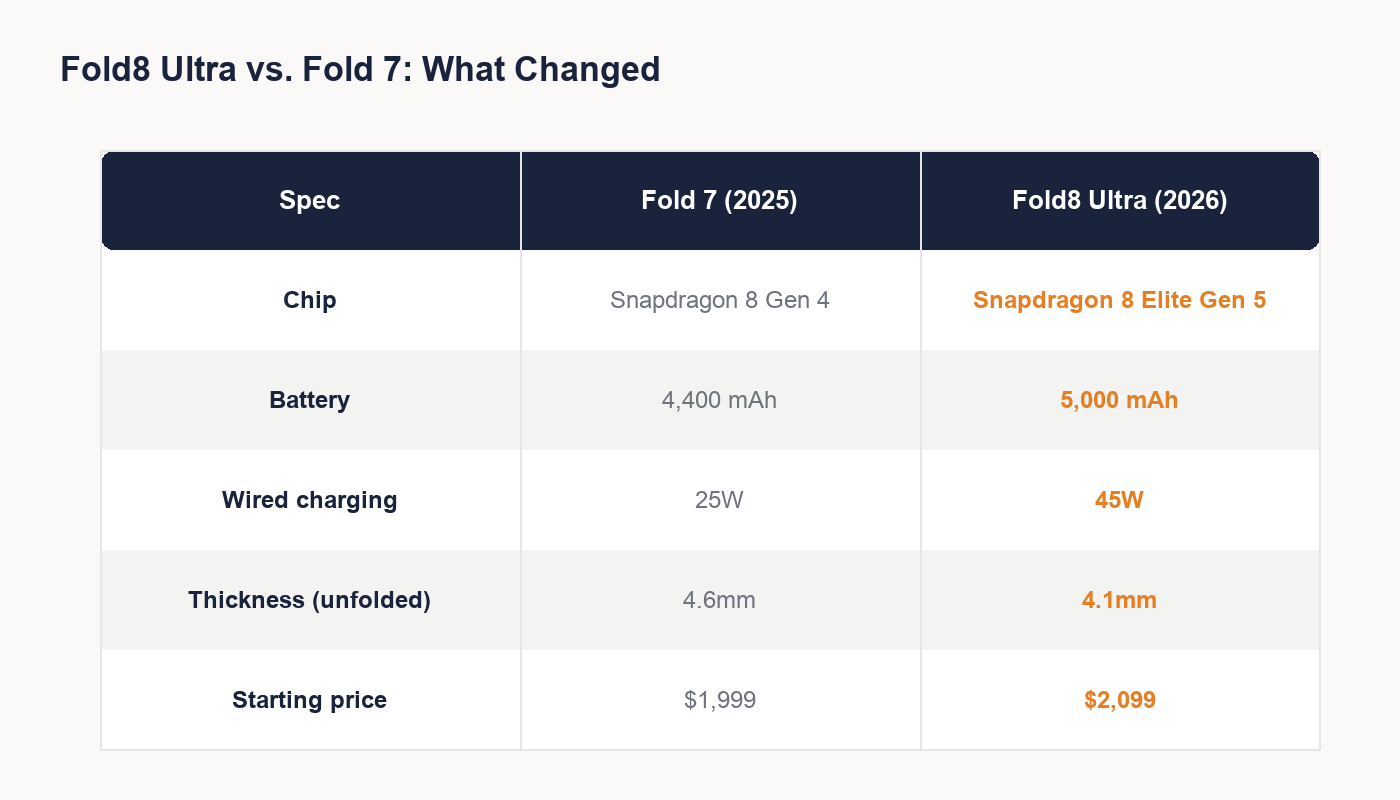
- Galaxy Z Fold8 Ultra — the direct follow-up to last year’s Z Fold 7. Same tall, phone-shaped design, but Samsung managed to make it thinner at 4.1mm unfolded while still growing the battery.
- Galaxy Z Fold8 — a brand new shape. It drops the tall-and-narrow look for a wider 4:3 screen, so it opens more like a small tablet than a stretched-out phone.
- Galaxy Z Flip8 — the smallest update of the three, but Samsung calls it the slimmest and lightest Flip yet at 6.1mm unfolded and 180 grams.
Samsung also refreshed its Galaxy Watch9 and Watch Ultra 2 lineup, and showed off new smart glasses built on Google’s Android XR platform — Samsung’s answer to Meta’s Ray-Ban glasses, though details on those are still thin. You can see the official rundown on Samsung’s newsroom.
Prices and release date
Here’s what you’ll pay, and when you can actually buy one.
- Galaxy Z Fold8 Ultra: $2,099 (256GB), $2,299.99 (512GB), $2,699.99 (1TB)
- Galaxy Z Fold8: starts at $1,899
- Galaxy Z Flip8: starts at $1,199
Every single model is $100 more than the phone it replaces. Preorders opened the same day as the announcement, July 22. General availability — meaning you can walk into a store and buy one — is Friday, August 7, 2026.
What actually changed under the hood
The headline spec bump is the chip: all three phones run Qualcomm’s Snapdragon 8 Elite Gen 5, the same chip family powering this year’s other flagship Android phones. Beyond that, the changes differ by model.
The Fold8 Ultra keeps the familiar 8-inch inner display and 6.5-inch cover screen, but Samsung squeezed in a bigger 5,000mAh battery (up from 4,400mAh on the Fold 7) while somehow making the phone thinner. Charging jumps to 45W wired, up from 25W last year, so top-ups should feel noticeably faster.
The Fold8 is the interesting one. Samsung gave up on the tall, narrow shape it’s used for years and went with a 4:3 ratio instead — wider and more compact when open, closer to a mini tablet than a stretched phone. It carries a 4,800mAh battery and the same 45W charging.
The Flip8 barely changed on paper but got noticeably slimmer and lighter, which matters a lot on a phone you fold shut and pocket dozens of times a day.
Why this matters if you’re not a Samsung superfan
You don’t need to care about foldables to feel the ripple effect. Samsung raising prices across its entire foldable line, on top of last year’s already-high prices, is a sign of where the whole premium phone market is heading — component costs are up, and every phone maker is passing that along. Apple raised iPhone prices in some regions this month too.
If you’re phone shopping and $2,000-plus for a folding screen makes you wince, that’s a completely reasonable reaction — a regular flagship like the upcoming Pixel 11 will cost far less and skip the fold entirely. The regular Fold8’s new wider shape is worth a look even if you’re not upgrading right now — it’s the first real design change to Samsung’s book-style foldable in years, and it might show up in future non-folding phones too, since screen shapes tend to trickle down.
If you already own a Fold 7 or Flip 7, none of this is a must-upgrade moment. The battery and charging bumps are nice, but not dramatic enough to justify a $1,800-plus jump unless your current phone’s battery is genuinely struggling.
How to preorder or buy one
Preorders are live now on Samsung’s website and through major US carriers. If you’re trading in an old phone, it’s worth comparing trade-in credit between Samsung.com and your carrier before committing — the numbers can differ by over $100 depending on the deal running that week. Some carriers, like T-Mobile, are already advertising steep trade-in discounts that can knock a big chunk off the sticker price. Retail availability starts August 7, 2026.
What’s next
Samsung didn’t share full details on the new Galaxy Watch9, Watch Ultra 2, or its Android XR smart glasses beyond pricing hints, so expect more specifics — and probably a dedicated hands-on — in the next few weeks. Reviews of the Fold8 and Fold8 Ultra should start landing right around the August 7 launch date, which is really the number that matters if you’re trying to decide whether the new wider Fold8 shape works for how you actually use your phone.
Frequently asked questions
How much does the Galaxy Z Fold8 Ultra cost?
The Galaxy Z Fold8 Ultra starts at $2,099 for the 256GB model in the US, with 512GB at $2,299.99 and 1TB at $2,699.99.
When does the Galaxy Z Fold8 release?
Samsung announced the Fold8 lineup on July 22, 2026, with general US availability starting Friday, August 7, 2026.
What’s different between the Galaxy Z Fold8 and Fold8 Ultra?
The Fold8 Ultra keeps the familiar tall, phone-shaped design and is aimed at Fold 7 owners upgrading. The regular Fold8 switches to a new, wider 4:3 screen ratio, giving it a more compact, tablet-like shape when unfolded. The Ultra also has a larger battery and higher-end camera setup.
Is the Galaxy Z Flip8 worth buying?
The Flip8 is Samsung’s slimmest and lightest Flip yet at 6.1mm and 180 grams, starting at $1,199. If pocketability matters more to you than a huge inner screen, it’s a reasonable upgrade from the Flip 7, though the spec changes are modest.
Are you upgrading to one of the new folds, or sticking with what you’ve got until prices come back down? Let us know in the comments.